Scintillation detectors: materials, readout and type numbers
A scintillator turns the energy of radiation into light, and a light detector turns the light into an electrical pulse. This guide compares the materials using Scionix’s own data and shows how the light is read out and how to read a type number.
Interactive table
19 scintillation materials compared
Showing 19 of 19 materials
Material
Density g/cm³
Emission max. nm
Decay time 1
Refractive index 2
Light yield 3NaI = 100
Hygroscopic
PbWO₄Physics research (calorimetry)
8.28
420
7 ns
2.16
0.20
No
CdWO₄DC measurement of intense X-rays, photodiode readout, computed tomography
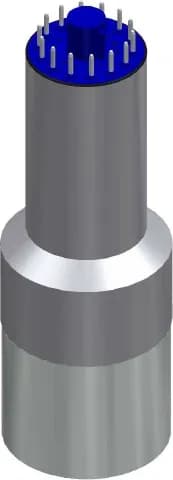
Cylindrical NaI(Tl) crystal, 76 mm x 76 mm – integrally mounted light detector, photomultiplier tube 3″ (76 mm).
–Geometry
Cylindrical (default)
76Diameter
76 mm
BCoupling
Integrally mounted light detector
–Window/housing
Standard 0.5 mm aluminium housing
76Height
76 mm
3Light detector
Photomultiplier tube 3″ (76 mm)
MElectronics
External solid µ-metal shield
E2Electronics
Voltage divider / preamplifier
–Material
NaI(Tl) (default)
Read by Scionix’s type number nomenclature. Parts that are not in it are marked as unknown. Specials (-X) are only described in Scionix’s drawing – ask us for the details.
How a scintillation detector works
Ionising radiation absorbed in the scintillator produces a short flash of light. A light detector – a photomultiplier tube, a photodiode or a silicon photomultiplier (SiPM) – turns the light into an electrical pulse. The size of the pulse follows the absorbed energy, so the detector can both count and measure energy.
Four properties that decide the choice
Density and atomic number decide how efficiently gamma rays are stopped. BGO, LYSO and CdWO₄ are dense; organic materials such as plastics are light and are mainly used for counting, not for spectroscopy.
Light yield: more light gives better energy resolution. The table above gives the photoelectron yield relative to NaI(Tl) = 100.
Decay time is how fast the light fades. It sets the time resolution and the count rates the detector can handle.
Moisture: hygroscopic crystals such as NaI(Tl), CeBr₃ and LBC are hermetically encapsulated. BGO is not affected by moisture and CsI(Tl) is only slightly hygroscopic.
Materials by task
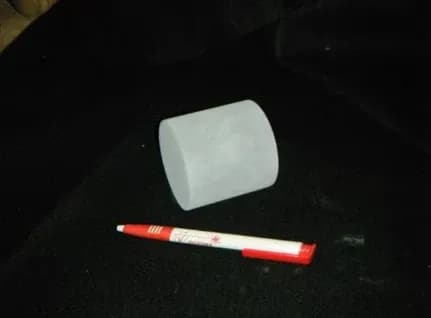
General gamma measurement: NaI(Tl) has a high light yield and good resolution and can be made large – NaI(Tl) crystals are made up to around half a metre in diameter. Scionix calls the 76B76/3M, a 76 x 76 mm crystal with a 3-inch tube, the standard detector for general gamma spectroscopy.
High resolution: proportional scintillators give better resolution than NaI(Tl). Scionix states 4% FWHM (typical) at 662 keV for CeBr₃, which has no La-138 background, 3% FWHM (typical) for LBC and approx. 3.5% FWHM for SrI₂(Eu).
Neutrons and gamma rays:CLLBC and CLYC contain ⁶Li and detect thermal neutrons – CLLBC gives a sharp peak at 3.1–3.2 MeV – and separate neutrons from gamma rays by pulse shape discrimination. For fast neutrons, the EJ-309 liquid scintillator is used.
Anti-Compton: dense BGO crystals around an HPGe detector give a veto when a photon is scattered out of the germanium crystal. For low-level counting, low-background NaI(Tl) is used instead – see the Compton suppression shields.
Alpha and beta: thin layers of ZnS(Ag), alone or together with plastic, are used for alpha and beta counting, for example in Scionix’s alpha/beta SiPM detector.
Photomultiplier tube, photodiode or SiPM
Photomultiplier tube: high gain, of the order of 10⁶ with 12 dynode stages, and good resolution. The tube needs high voltage and shielding against magnetic fields, and its gain typically changes by 0.2–0.3% per °C.
Photodiode: needs no high voltage, only about 30 V, and gives a stable signal – but the noise sets a lower energy limit: about 40 keV for a 1 cm³ CsI(Tl) cube with a 10 x 10 mm photodiode. Used below 50 °C.
Silicon photomultiplier (SiPM): low voltage (25–30 V), compact and insensitive to magnetic fields, with a gain around 10⁶. The gain changes by more than −1% per °C, so Scionix builds in a temperature-compensated bias generator. Scionix’s new SiPM detectors run on 5 V, less than 5 mA.
The configuration: crystal, integrated or demountable
C – crystal without tube: the crystal comes in a sealed housing with a window for the customer’s own tube. With a well for the sample, the style is called CP.
B – integrated: crystal and tube are coupled directly and sealed together. This is the most common configuration, and the direct coupling gives better, guaranteed resolution.
A – demountable: the tube can be replaced by the user. This is normal for large detectors such as anti-Compton shields and whole-body counters.
Thin windows: 25–30 µm aluminium is used down to 10 keV, 0.2–0.3 mm beryllium for lower energies and aluminised Mylar for alpha and beta particles – only on materials that are not affected by moisture.
Reading a type number
Scionix’s type number describes almost the whole detector: the crystal size, how the light detector is coupled, window and housing, the light detector, the electronics and the material. 76B76/3M-E2, for example, is a 76 x 76 mm NaI(Tl) crystal integrated with a 3-inch photomultiplier tube, with a µ-metal shield and a voltage divider with preamplifier. Try it with the type number reader above.
Low background
When low activities are measured, part of the background comes from the detector itself: potassium-40 in the tube glass and traces of uranium and thorium in the housing and window. Low-background detectors have quartz or undoped NaI light guides between crystal and tube, a steel or copper housing and selected components. NaI(Tl) itself has a low background – its potassium content is typically below 1 ppm – while BGO, CsI(Tl) and the lanthanum halides have a background of their own.
Would you like help choosing? Contact us with the measurement task and we will work out the right configuration together with Scionix.