What energy resolution means
A gamma detector does not record a gamma line as a sharp line but as a bell-shaped peak. The width of the peak is given as FWHM – full width at half maximum – in keV or as a percentage of the energy. For scintillators and CZT the value is usually stated at 662 keV (Cs-137), for HPGe detectors at 122 keV (Co-57) and 1,332 keV (Co-60).
The narrower the peak, the easier it is to separate neighbouring lines and to see weak peaks on top of the background. In the chart above, the same Eu-152 source has been calculated for four detector materials. Look at the lines at 1,085.8 and 1,112.1 keV: with NaI(Tl) and LaBr₃(Ce) they merge, while CZT and HPGe show two clearly separated peaks.
The materials in brief
NaI(Tl) – sodium iodide
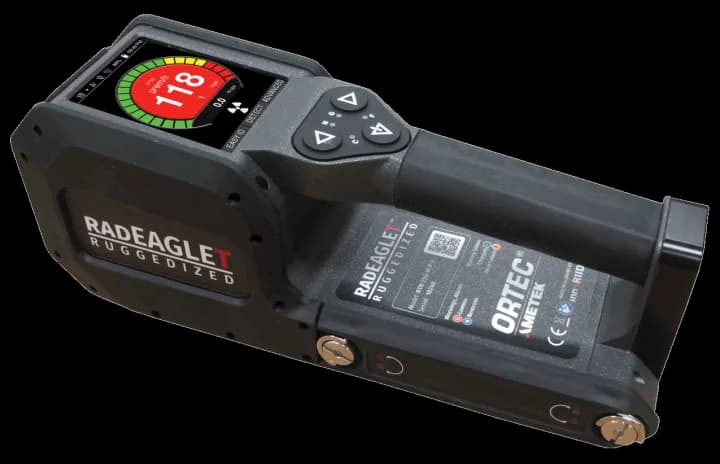
A scintillator that can be produced in large volumes at reasonable cost and works at room temperature. The crystal is hygroscopic and therefore always hermetically encapsulated. Its resolution is the lowest of the four materials – ORTEC states ≤ 7.2% FWHM at 662 keV for RADEAGLET-R with a NaI(Tl) crystal – but a large crystal gives high sensitivity. NaI(Tl) is common in handheld identifiers and fixed monitoring systems.
LaBr₃(Ce) – lanthanum bromide
A scintillator with clearly better resolution than NaI(Tl) at room temperature: ORTEC states ≤ 3.2% FWHM at 662 keV for RADEAGLET-R with a LaBr₃(Ce) crystal. The material contains naturally radioactive lanthanum-138, which adds a small intrinsic background to the spectrum that can be noticeable at very low activities.
CZT – cadmium zinc telluride
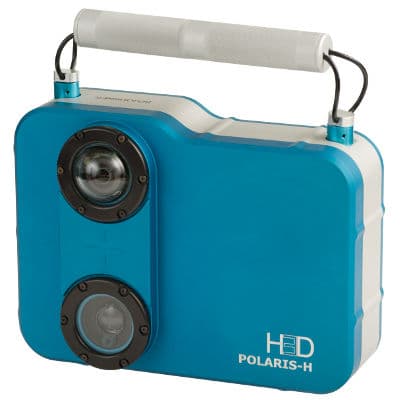
A semiconductor that, unlike germanium, works at room temperature. The radiation is converted directly into an electrical signal, without going through light, which gives high resolution in a compact instrument. H3D states < 1.1% FWHM at 662 keV for the H100, H400 and H420 in the H Series and < 0.8% for the plus versions. The detector volume varies between models – from 6 cm³ in the H100 to more than 77 cm³ in the H1600 – and the H Series also shows where the radiation comes from.
HPGe – high-purity germanium
Gives by far the best resolution and is the standard for laboratory measurements and demanding nuclide analysis. ORTEC warrants, for example, ≤ 0.87 keV at 122 keV and ≤ 1.8 keV at 1.33 MeV for the GEM40. The germanium crystal must be cooled to cryogenic temperature during operation, with liquid nitrogen or an electro-mechanical cooler, which makes the systems larger and more expensive.
Resolution is not everything
The right material depends on the task. A larger crystal captures more photons and shortens measuring times, so a large NaI(Tl) detector can be a better choice than a small detector with higher resolution when a source has to be found quickly. When several nuclides must be identified in a complex spectrum, or the activity of a sample determined accurately, HPGe is normally the first choice. LaBr₃(Ce) and CZT are often used in handheld identifiers, where both resolution and weight matter.
How to read resolution in a data sheet
- Energy: check at which energy the value applies – 662 keV is most common for scintillators and CZT, 122 keV and 1,332 keV for HPGe.
- Typical or warranted: a maximum value (≤) is a guarantee, a typical value is the normal outcome.
- Percent and keV: the values can be converted. 7% at 662 keV corresponds to about 46 keV FWHM.
- Conditions: resolution applies under stated conditions. The RADEAGLET-R values apply at room temperature, for example, and ORTEC’s HPGe values are measured according to ANSI/IEEE Std 325-1996 with a specified signal processor.
Want to see which instruments use a particular detector type? Use the Detector type filter in the product catalogue or start from the task in the instrument finder.